Why Leave Out Billa & Ranga?
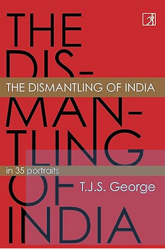
The Dismantling of India: In 35 Portraits (2022)
by TJS George
The recently departed TJS George (1927-2025) was a respected Indian journalist, striding tall in a profession with few genuine stars.
Quietly and with no drama, George built a sterling reputation with quality work spread over several decades.
Yet after reading the foreword of George’s The Dismantling of India: In 35 Portraits (2022), I wondered if the author, a former journalist with the Indian Express, had taken leave of his senses.
After all, George was 94-years-old when the book came out and it’s not uncommon to lose one’s marbles at that age.
In the foreword, George makes the grandiose claim of constructing a history of India through 35 profiles of “personalities that have dominated the nation’s attention for 75 years.” The personalities selected come from different walks of life: murderers, assassins, gangsters, bandits, freedom fighters, politicians, film stars, etc.
The sheer effrontery of cobbling together a bunch of profiles (Dawood Ibrahim, Rajinikanth, Nathuram Godse, Amitabh Bachchan, Girish Karnad, Veerappan, MGR, Rahul Gandhi, MK Gandhi, Sanjay Gandhi, Harshad Mehta, et al) that George had originally published eons ago in the Indian Express and staking a claim for this to be a history of India is madness.
Still I was willing to give the man the benefit of the doubt. Maybe, the old geezer was taking a different approach to history. Perhaps, George had devised a new technique to understand Indian history by tracing the life story of the notorious bandit and poacher, Veerappan. Best to keep an open mind, right?
But after reading the 383-page book, my initial doubts were confirmed. This book is far from a history of India. Just 35 profiles. There is no larger framework that connects these 35 profiles.
Given that George’s “history of India” includes brigands, terrorists and assassins such as Veerappan, Dawood Ibrahim and Nathuram Godse respectively I was surprised at the omission of rapists and murderers like Billa and Ranga, and the Mumbai serial killer Raman Raghav. If he'd lived a few more years, the next edition of George’s "history of India" would have included Billa, Ranga, Raman Raghav, and the Jamtara scammers.
If you ignore the nonsense of George’s history claims, the profiles themselves are interesting although few provide anything new to old fogies like me, a daily reader of newspapers and magazines. But youngsters (Gen-Z, Gen-Alpha and Millennials) will learn a lot about some of the yesteryear news-makers.
My favorite was the profile on the publisher P.Lal and his fellow travelers in the book business like K.S.Padmanabhan and T.N.Shanbhag.
George was a well-read journalist and his erudition is reflected in the profiles.
There are some shortcomings in the book here and there. The joint profile of Indira Gandhi and Rajiv Gandhi has very little about Rajiv. The profile of Mahatma Gandhi takes no note of Indians turning their collective backs on the apostle with rampant corruption, indifference to public hygiene and frequent resorts to violence in both the urban and rural domains becoming the norm in the post-Gandhi era.
Also, notable Indians like Medha Patkar, Baba Amte, Jaiprakash Narayan, Vinoba Bhave, Morarji Desai, L.K.Advani, Manmohan Singh and Arvind Kejriwal are missing from the profiles. Surely, they played a bigger role than Harshad Mehta, Nathuram Godse and Veerappan in Indian history of the last 75 years.
Also, George has precious little to say about the Indian people. It’s all fine and dandy to lay into political leaders like Sanjay Gandhi, Indira Gandhi and many others. But don’t the Indian people bear any responsibility for the failings of their nation?
Another vexing aspect of the book is the lack of an index.
For me, The Dismantling of India was still worth lingering over even if the broad outlines of several of the profiles were already familiar. Consider that my tribute to George.