Is it All Foreign to You?
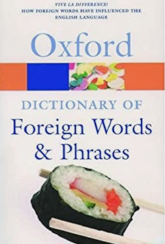
Oxford Dictionary of Foreign Words & Phrases (2005 edition)
Edited by Jennifer Speake
Nothing lifts up a speech or a piece of writing in English than an apposite Sanskrit, Bengali, Hindi, French, German, or other foreign word or phrase inserted in the right place.
Why write: The military attacked the legislative buildings and overthrew the government in Nigeria last night when use of a single word “coup” triples the punch of the sentence: The Nigerian military staged a coup last night!
I’ve already picked up scores of unfamiliar words from the Oxford Dictionary of Foreign Words & Phrases (512-pages).
For instance, I was familiar with the French term hors d’ouevre (appetizer, starter) but not hors de question (out of the question) or hors de combat (injured, in a disabled condition).
Also, thanks to this book I’m now familiar with the names of two Indian musical instruments: surbahar and esraj. Both words are from Bengali.
There’s a nice index at the end that helps users find foreign words by language (Sanskrit, Hindi, French, German, Russian, Italian, etc.).
Like with most English word power books I’ve pored over, this one too has its flaws.
Sometimes, words do not have their primary meaning but include only a secondary meaning. Let’s consider the Hindi word dilruba (P.113 of the book)
I’ve encountered the word dilruba in multiple Bollywood films, mostly in song-dance sequences. The word means a beloved person or someone enchanting or charming.
But the book neglects to provide the primary meaning but merely mentions that it is a North Indian bowed string instrument.
Also words I expect to see are missing. Let’s consider mulligatawny: The word, originally from Tamil, means a pepper soup and is found in most dictionaries. But it’s missing in this book.
For the sheer volume of foreign words, Oxford Dictionary of Foreign Words & Phrases is worth a dekko notwithstanding its inadequacies.