Indian Politics Made EZ
Guys, fasten your seat belts and sit tight.
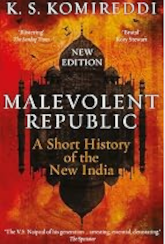
Freelance journalist Kapil S. Komireddi is on a tear in his first book,
Malevolent Republic: A Short History of the New India.
First published in 2018, a “revised and updated” edition of the book came out in 2023.
The updated edition that I read in 2026 is a 197-page rant.
To those unfamiliar with India, the book might be appealing and serve as a primer to understanding the post-independence history of the country. The author writes with passion, in sterling prose and covers much ground in little space.
But if you’re an old fogey like me, a reader of Indian newspapers and magazines for decades, familiar with the works of scholars like Rajni Kothari, Ramachandra Guha, Bimal Jalan, Bipan Chandra, Ashoka Mody, etc., and a frequenter of libraries, then Malevolent Republic is a waste of time.
I found little that was new in the “Revised and Updated” edition of Malevolent Republic.
Everything in the book has been adequately covered by Indian journalists and scholars (foreign and Indian) starting from the late 1970s, or even earlier. Some may charge Komireddi with merely bringing a shrill tone to his rehash.
Like Dirty Harry, Komireddi is all the time in a Make My Day mood ready to take shots at leaders of all stripes. Few leaders escape his acid-dripping pen: Indira Gandhi, Sanjay Gandhi, Manmohan Singh and Narendra Modi are all severely mauled by Komireddi’s pen.
In Chapter 4: Dissolution, the author lays bare the vicious assaults on the poor and tribals by the Manmohan Singh government. “The severest bruises of Singh’s reforms were borne by the historically marginalized and trod-upon layers of Indian society,” Komireddi writes.
After reading the chapter, few will disagree that the saintly aura surrounding the late Indian Prime Minister is completely undeserved. Komireddi savages Manmohan Singh as “the sub-continental Pinochet.” I’d rate this chapter the best in the book.
But the author reserves his most vicious jibes for Narendra Modi, the BJP leader and Prime Minister since 2014. Komireddi makes no secret of his loathing for Modi and lashes out at him as the “worst human being ever elected Prime Minister.”
The author is relentless in blaming Narendra Modi for problems galore: Foreign policy crises, relations with Pakistan, demonetization, border clashes with China, rise of Hindu chauvinism, handling of Covid-19, etc.
But Narendra Modi must be doing something right. Let’s not forget his performance in the polls: Modi and his BJP have won three parliamentary elections in a row (2014, 2019 and 2024) in elections that were free and fair. Even in the 2024 Lok Sabha elections, the BJP got 36.56% of the votes polled. The Congress party came a distant second with 21.19%.
Clearly, the BJP government and Narendra Modi himself are resonating with several hundred million Indians. Plus, the BJP is in power in 22 states attesting to its popularity. Because of Modi’s history as a RSS worker, his entrenched position in the party and the failure of the opposition parties to provide a strong alternative, he has no challengers. It’s only among India’s youngsters that Modi’s sheen is now fading due to the slow pace of job creation.
Strangely, Komireddi lets the Indian people off the hook for the most part.
It’s fine and dandy to blame our political leaders but what about the Indian people. Don’t we the people bear some responsibility for the mess we’ve made of our nation after the British left? Several million Indians, belonging mostly to the educated classes, made a mad dash for the exit gates at the first opportunity while those staying back are preoccupied with the Sensex, TV soaps or Bollywood films.
Also, constant survival anxiety has put several hundred million Indians into severe angst and they flare up at the slightest provocation leading to frequent instances of violence against other people and destruction of public property. This has made India often ungovernable and provided credence to JK Galbraith’s memorable description of India as “a functioning anarchy.”
Another disappointment in a book that claims to be “A Short History of the New India” is the scant attention paid to the economy, decline of manufacturing, growth of the service sector, dismantling of public sector giants like HMT, ITI, etc., environmental degradation and the corruption plaguing the land.
I’d have also liked the author to address corruption at greater length. There is a miasma of corruption surrounding most public works projects in India whether it’s the acquisition of guns from Bofors or construction of a bridge. To be fair, the author mentions “bottomless corruption scandals” (p.142) and touched on it in an earlier chapter as well but fails to dig deep into the plague gripping the nation. In India, it’s impossible to get anything done at any government level without dropping a baksheesh into an extended palm. Unfortunately, investigations into corruption scandals of self-serving grifters aka our political leaders end up nowhere.
Bad policy choices have also been ignored. For instance, starting in the late 1980s India decided to put all its IT eggs in the software basket. This created far too few jobs. Instead, if India had embarked upon a hardware-assembly model a la China tens of millions of jobs would have been created.
To his credit, Modi has been aggressively wooing Western nations with a Make-in-India strategy but, alas, it’s too late. China has wrapped up the hardware market.
Given the author’s exclusive focus on larger than life figures like Indira Gandhi, Sanjay Gandhi and Narendra Modi, it’s unsurprising that a bigger failure is his inability to marshal the huge volume of facts he’s gathered into theoretical frameworks that researchers can use to understand Indian politics. For instance, Rajni Kothari’s decades-old Politics in India included a discussion on the dominant party system in India, an interesting concept that helped researchers on Indian politics in the 1960s and 1970s to understand the Congress party.
Institutional rot is another topic that escapes Komireddi’s attention as his focus is more on individual political actors.
For those not familiar with India, Malevolent Republic is a good primer and Komireddi deserves thanks. The rest can give it a pass.